My Tech Journal - June 2026
My Tech Journal - June 2026 Edition
Database
- Monster Scale Summit 2025 Time Travelling at Scale by Richard Hart
- Richard Hart talks about Pangolin, a purpose-built analytical tree-database created at Antithesis to replace BigQuery.
- The database is designed to record data (fault injection, logs, code coverage etc.) at every state of the simulation with a performance objective to support 100 concurrent queries with P99 query performance of 5 seconds, over a 1 TB dataset.
- Implemented in Rust; supports ACID transactions; append-only with log-structured merge tree 1
- Uses Amazon S3 for blob storage and AWS Lambda
- Another interesting implementation detail is the use of Skiptree - a data structure inspired by Skip list.
- Richard Hart talks about Pangolin, a purpose-built analytical tree-database created at Antithesis to replace BigQuery.
Data Structure
- What are skiplists good for?
Will Wilson provides the rationale for creating the Skiptree data structure used in the Pangolin analytics tree-database developed in-house. - Context: Antithesis simulation testing results in a branching tree of timelines where each path from root to a leaf node represents a sequence of events leading to a specific outcome (e.g. log message / error / crash). In order to investigate an outcome, users want to know the exact sequence of events leading to that outome, which is essentially traversing up the tree from the leaf node to the root.
- Earlier Antithesis used BigQuery, but due to this unconventional use-case for an analytics database, every operation resulted in a full table scan. Not only the queries were really slow, but it was also expensive.
- Solution: They designed Skiptree - a new tree data structure that’s modeled to work like a Skip list, where each tree has roughly 50% of the nodes from the levels below.
- Each level of the Skiptree is stored as a separate table in the database and you can get the sequence of events by JOINing together tables from the leaf node to the root node.
Distributed Systems
- Diptanu - Chaos Engineering and design patterns for building highly available services
Apr 16, 2016
- Distributed systems are hard to operate and have complex failure modes.
- This is an excellent presentation covering
- several kinds of failure scenarios
- tools for testing distributed systems and
- patterns for desiging highly available and resilient distributed systems.
- Distributed systems are hard to operate and have complex failure modes.
LLM Engineering
- Webinar recording: Observing and Improving AI Agents with Langfuse
Clemens Rawert, co-founder, Langfuse and Doneyli de Jesus, Solutions Architect, ClickHouse, May 27, 2026
Langfuse is an open source (MIT license) LLM engineering platform to develop, monitor, evaluate and debug AI applications.
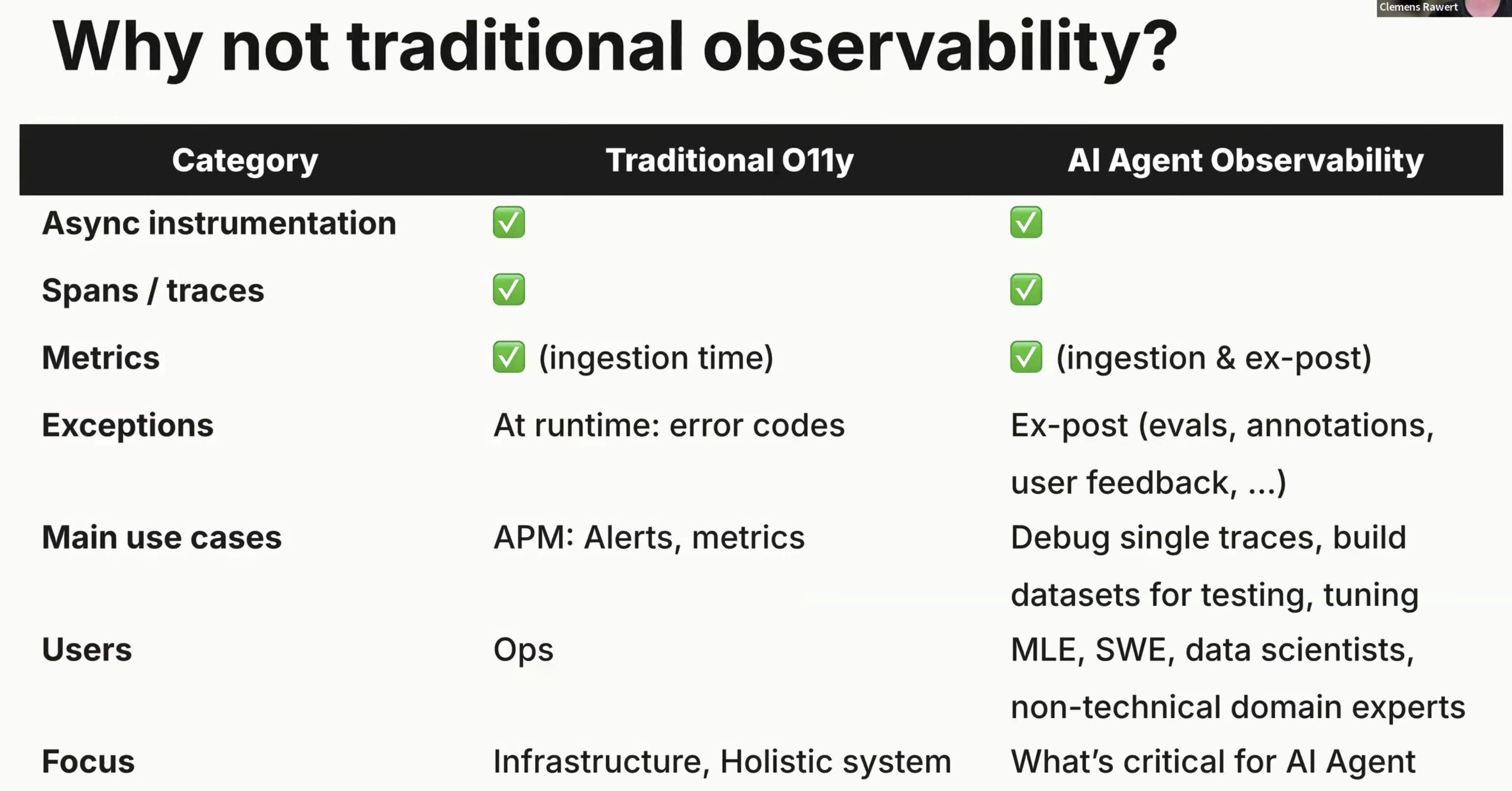
The case for Langfuse:- GenAI is not deterministic
- problems are hard to anticipate and hard to reproduce - the traditional system metrics look green, but an AI agent may have failed to provide the correct answer …
We need both - the traditional observability + AI agent observability
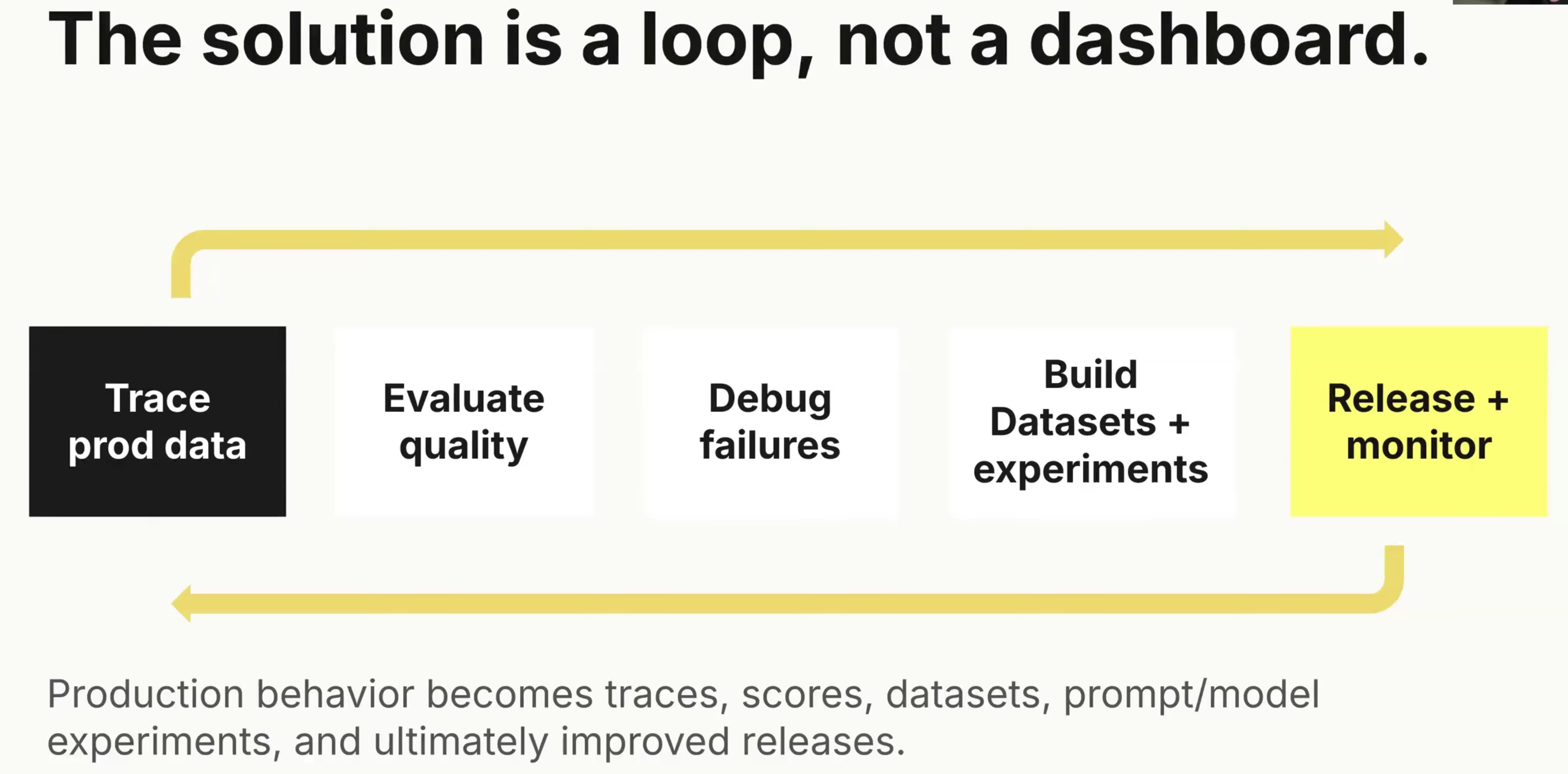
- The solution is an observability loop, not a dashboard.
- Links for further exploration:
- Langfuse Academy - good resource for learning concepts
- Langfuse Workshop
Software Engineering
-
The principles behind great API design: Stripe Sessions 2019, Sep 20, 2019
3 core principlesI. Put users first
Build for the users of today, but consider your platform of tomorrowII. Spend time to make it good
Build for the buildersIII. Design Your Organization
Can you harness Conway’s Law? [^2]
References
-
VictoriaLogs and ClickHouse are other high performance products that use some form log structure merge tree.
- Guide to self-hosting [^2]: Conway’s Law describes the link between communication structure of organizations and the systems they design.