My Tech Journal - May 2026
My Tech Journal - May 2026 Edition
AI Agents
-
AI Agent Conference 2026: Alex Gallego presents the Agentic Data Plane
by Alex Gallego, May 22, 2026• What is an Agent?
- the prompt
- set of tools
- tokens alloted
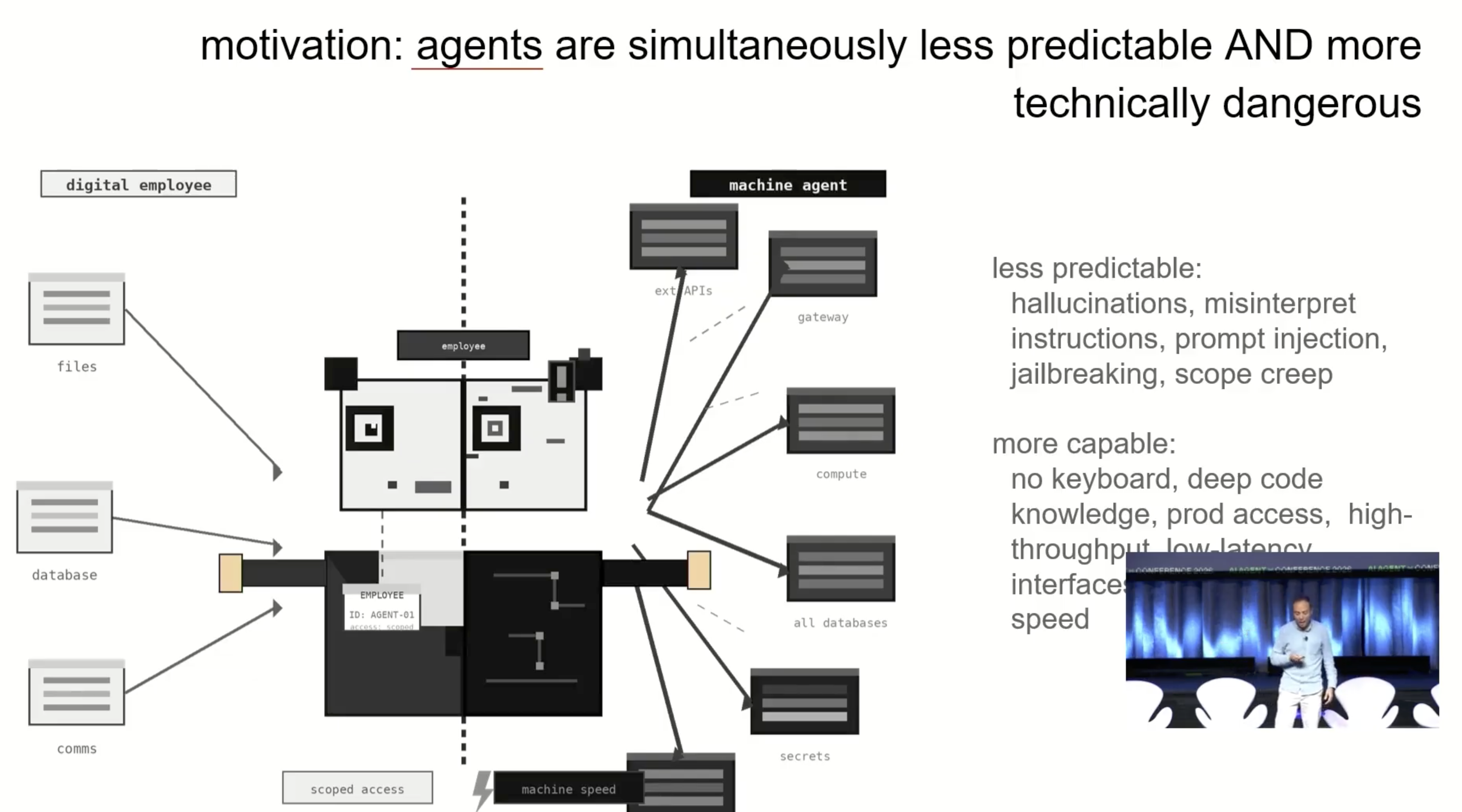
• In an enterprise, you want the agents to have access to a fixed set of (approved) tools. An agentic data plane focuses on
- trust,
- explainability and
- context
and offers controls to deploy regulated enterprise agents in production.
• How to unlock private data to AI agents in a safe, auditable manner?
The proposed architecture of an agentic data plane for the enterprise.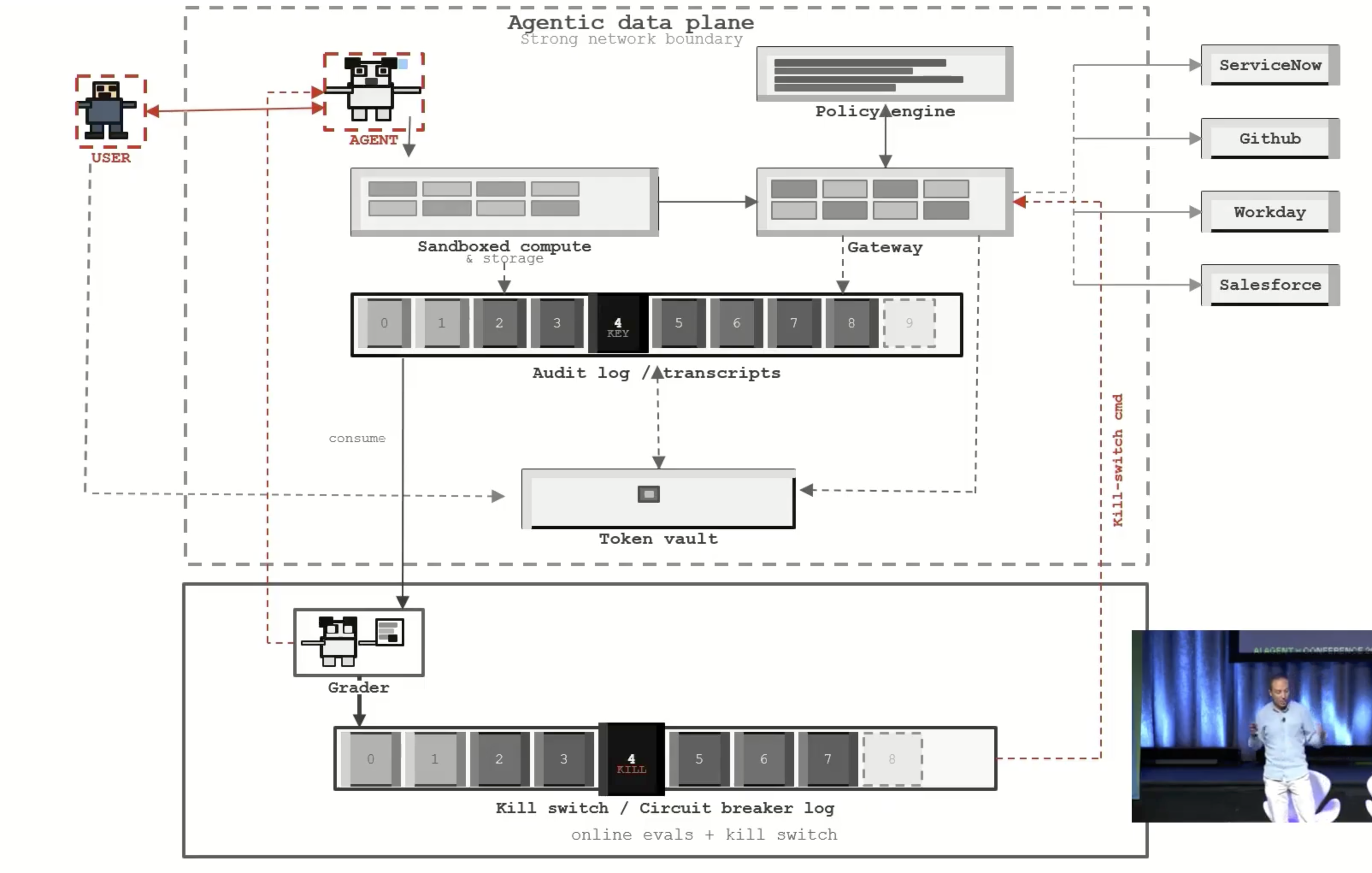
• An audit log is an immutable transcript of agent actions along with the return payload in OpenTelemetry (OTel) format
• The desired properties of an Audit Log:
- immutable, complete, provably correct
- survives ‘f’ node failures, given ‘2f + 1’ nodes
- empirically verifiable
C++
- Effective Ranges: A Tutorial for Using C++2x Ranges - Jeff Garland - CppCon 2023
• C++20 is the first official standard that introduced ranges.
• Ranges are the largest revamp of the Standard Template Library (STL) in 20 years and impacts daily C++ programming dramatically.
• This tutorial offers an excellent overview of ranges, views and spans.
• Ranges algorithms are not fully compatible with STL algorithms.
• Views are ranges with lazy evaluation and lazy evaluation allows for composition of several processing steps. This allows us to writefunctional stylecode.
• If you are on older releases of C++, say, C++14 or C++17, then Eric Niebler’s range-v3 library allows you to use ranges.
eBPF
- XDP-Programmable Data Path in the Linux Kernel by Diptanu Choudhury
;login: Spring 2018 Vol 43, No. 1
• an easy to read, short introduction to eBPF and XDP
• offers a high level overview of XDP-based Firewall service
GenAI
- ghost
• ghost is a hosted database (Postgres) service for agentic AI use-cases
• emphasizes a Git like fork model to give every agent its own fork (copy) of the production database
• after testing and validation, changes from the fork are merged into the production database and the fork is discarded
• enables several agents to work in parallel without affecting the production database
• offers Skills and MCP integration to work with several frontline products
Golang
- Debugging Go: from zero to Kubernetes - Michele Caci
by Michele Caci
• good introduction to debugging Go applications on local node, in docker container and in kubernetes environment
• GitHub repo: Debugging Go: from zero to Kubernetes • Delve is a debugger for the Go programming language. As per the offical documentation,Delve is a better alternative to GDB when debugging Go programs built with the standard toolchain. It understands the Go runtime, data structures, and expressions better than GDB.
Infrastructure
- Creating our Own Kubernetes & Docker to Run Our Data Infrastructure - Modal
- The architecture of VictoriaLogs
by Aliaksandr Valialkin, CTO, VictoriaMetrics
• Nice high level overview of various design decisions that make VictoriaLogs really compact, fast and efficient
• Implemented in Go
• There are some similarities with ClickHouse e.g.
- uses LSM tree to take advantage of the fact that the (log) file contents never change
- logs are split into blocks of upto 2 MiB (compared to 8 MB - the default granule size in ClickHouse)
Each block fits into typical CPU cache. This cache friendly design decision probably gives it a huge advantage. - The sequential disk I/O benefits both the write and read use-cases
- column-oriented storage that allows for better data compression ratios
- use of Bloom Filters
- uses LSM tree to take advantage of the fact that the (log) file contents never change
Testing
- Testing Distributed Systems the right way ft. Will Wilson
The Geek Narrator • Jun 12, 2024
- References mentioned in the conversation
- Conventional Testing:
a) Good for catching regressions
b) Tests are fragile; they are dependent on implementation details of the system under test - Property Based Testing
an idea from functional programming
you always expect some property of the system to hold
OR
you never expect certain behavior from the system - Deterministic Simulation Testing
a) applying fuzzy or Property Based Testing approach to distributed systems
b) build mock implementation of all the parts of your system that could be non-deterministic - Autonomous Testing
Tests are generated by a computer to cover scenarios that you didn’t think about
- References mentioned in the conversation